
One clogged drain is a fixture problem, every drain is a line problem
Your home's drains join into one main line that leaves the house and meets the sewer service line. A clog in a branch affects one bathroom or the kitchen. A clog in the main stops everything, because wastewater has no way out. Water you run upstairs shows up as gurgling, slow flow or a backup at the lowest opening.
That lowest opening is your best clue. A basement floor drain, a basement shower or a tub on the lowest floor is where water surfaces first. If that drain bubbles or fills when the washing machine runs, the main is blocked.
While sewage is backing up into the house
A main-line backup gets worse every time anyone uses water, and the water coming up is wastewater, not clean water. Call the 24/7 line if it is rising or smells. Until help arrives, these steps limit the damage.
Keep people and pets out of the affected area while you wait.
- Stop all water use. No flushing, laundry, dishwasher, showers or running taps.
- Keep children and pets out of the wet area and wear boots and gloves if you must enter.
- Move rugs, boxes and anything stored on the basement floor out of the water's path.
- Do not pour chemical drain cleaner into the main. It can pool in a blocked pipe and burn whoever opens it later.
- Switch off power to a flooded basement only if you can reach the panel without standing in water. Otherwise leave it for the plumber or the utility.
Reading the symptoms: where the clog sits
Pattern tells you more than any single slow drain.
| What you see | Where the clog likely is | Next move |
|---|---|---|
| One sink slow, rest fine. | That fixture or its branch. | Plunge or snake the trap. |
| Two fixtures on the same floor slow. | Shared branch line. | Call for cable clearing. |
| Toilet gurgles when shower drains. | Main or main vent. | Stop water use and call. |
| Basement floor drain backs up. | Main line, downstream of everything. | Call the 24/7 line. |
| Backups repeat every few months. | Roots, bellied pipe or buildup. | Camera inspection. |
If the main is clear and only the toilet bubbles, a blocked vent stack can cause similar symptoms. A plumber can tell the two apart in minutes.
What the visit looks like
Plumbers do not guess at a main-line clog. The sequence is simple and the tools are specific.
Find the cleanout
Most homes have a capped cleanout near the foundation or in the basement, which gives straight access to the main. Without one, the plumber may pull a toilet or work from a roof vent. A homeowner who has never seen the cleanout should find it now, before a backup, and keep the area around it clear.
Clear the blockage
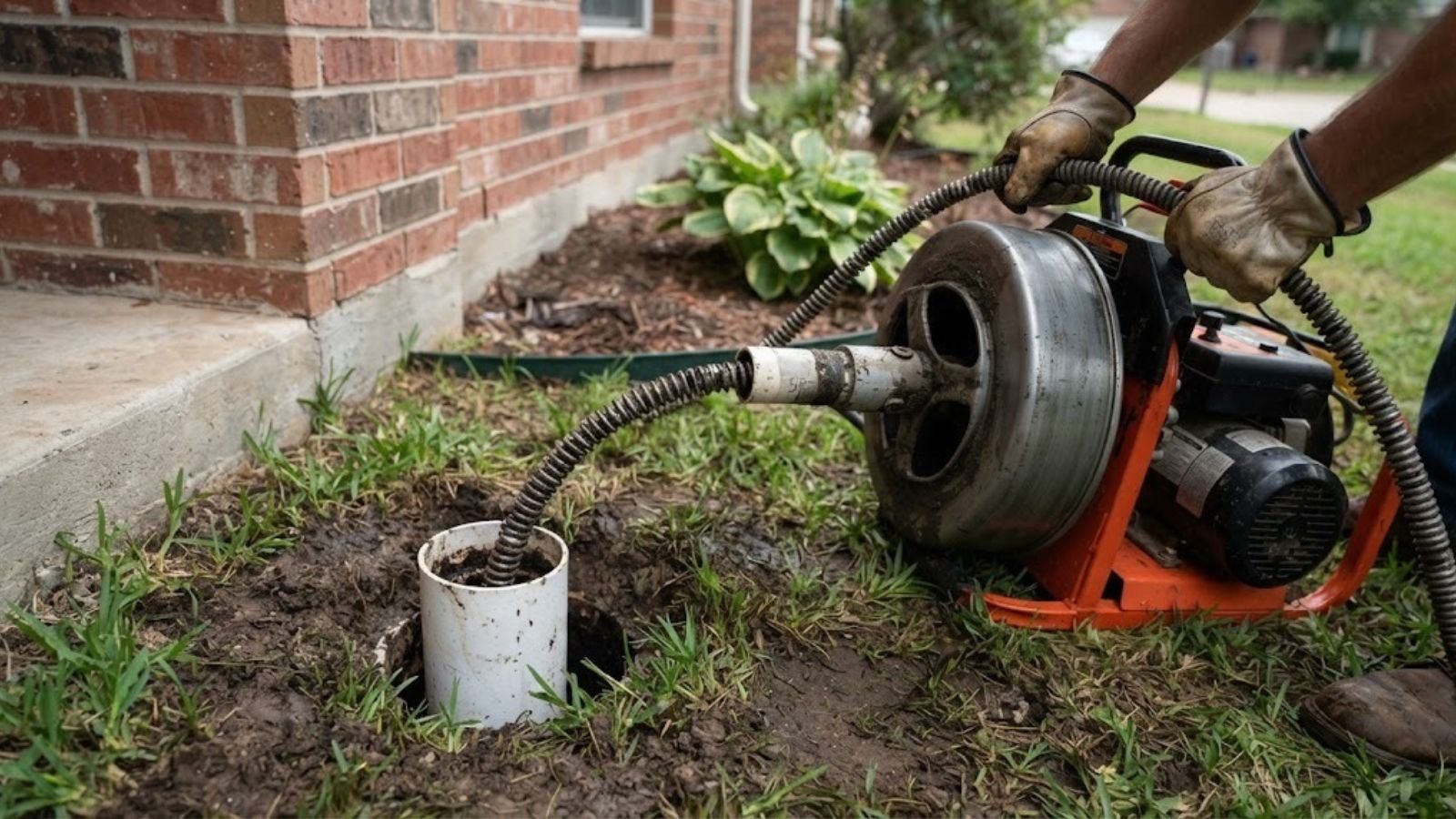
A sewer machine with a rotating cable cuts through roots and soft stoppages. Heavy grease or scale calls for a hydro jetter, which blasts the pipe wall clean with high-pressure water. This is the core of sewer line cleaning.
Send a camera down the line
A drain camera shows why the clog formed. Roots at a joint, a belly where water pools, an offset joint or a collapsed section each need a different fix, and a camera recording documents it.
Decide cleaning versus repair
If the pipe is sound, the cleaning may be enough. If the camera shows a break or a belly, the lasting answer is a sewer line repair.
The usual causes behind a blocked main
A main rarely blocks for no reason. These are the causes plumbers meet most often.
Tree roots
Roots slip into joints looking for moisture and grow into a mat that catches paper. Cleaning clears them, but they return unless the joint is repaired.
Grease and wipes
Grease coats the pipe wall and gradually narrows it, and wipes labeled flushable do not break down. The two together form a plug.
A bellied pipe
A sagging section holds standing water and solids settle there. Repeated backups from the same spot usually mean a belly.
A broken or offset section
Settled soil can shift a joint or collapse an old pipe. Cables hit a hard stop, and only digging or relining restores flow.
What Wayzata homeowners should know about public and private pipe
Sewage that backs up inside your house is not always your pipe's fault, but the first assumption should be that the problem sits on your side. Wayzata's Public Works Utility Department runs the city's sanitary sewer, including lift stations. Water, sewer or street emergencies there go through Hennepin County Dispatch.
If neighbors report backups at the same time, or you see water coming out of a street manhole, call dispatch about the public main. If only your house is affected, the blockage is likely in your private line, and a camera shows quickly which side it sits on. When unsure, ask the city before paying for repairs.
Source: City of Wayzata Public Works Utility Department page.Plymouth and Wayzata homes: what age and lot size tell you
Plymouth grew from about 31,600 residents in 1980 to over 81,000 by 2020, so much of its housing dates to the decades when plastic drain pipe was already common. Roots still force their way into joints, and a camera from a Plymouth plumber shows the condition of a lateral without digging.
Wayzata's older neighborhoods on large lots, such as Holdridge and Highlands, can mean a long private line from house to street, and that is a lot of pipe for roots to find. A Wayzata plumber can run a camera before and after clearing so you know whether roots are returning. Ask for the recording.
Keeping the main clear afterward
Flush only toilet paper and human waste. Keep grease out of the kitchen drain and wipe pans first. If a camera found roots, plan an annual cleaning, or fix the joint they enter. If it found a belly or break, repair it, because cleaning a failing pipe is a recurring cost.
Check licensing for any plumber you hire at the Minnesota DLI Check a License lookup. Plumbing contractors serving Minnesota communities with more than 5,000 people must be licensed.
Questions about this topic
Because they all feed one main line, and that line is blocked or partly collapsed. A fixture clog stays at the fixture. A main clog backs up the lowest drains first, then the rest.
A rented drum machine can reach some clogs, but it is heavy, messy and hard to control. If the cable hits a hard stop, you have a break, not a clog. Call a plumber with a camera.
No. The chemicals sit in standing wastewater, can splash, and do little against roots. Never mix cleaners. Wear eye protection if anything must be handled.
Yes, until the line is cleared. Every flush or load of laundry adds wastewater that has nowhere to go, and it surfaces at the lowest drain.
It depends on the policy. Many standard policies exclude sewer or drain backup unless you added a rider, and gradual damage is usually not covered. Read your policy and call your insurer.
Call Hennepin County Dispatch for sewer or street emergencies on the public side. If it is only your house, call a licensed plumber, since a camera shows which side the clog sits on.
Related plumbing help
If this problem is happening now, these pages cover the work and the towns the 24/7 line serves.