The snake cleared it, and the problem returned
This is the most common reason people call us for jetting. A cable went through the line, water ran for a few days or weeks, and then the same slow drain came back. That pattern means the blockage was never just a plug. Something is coating or invading the pipe, and the cable only drilled a hole through it.
Look for these signs. The clog returns every few weeks. Every fixture on the lowest floor drains slowly, not just one. Water gurgles in the basement drain when a washer empties upstairs. A tree stands near the line from the house to the street.
Any of these suggests grease buildup, scale or roots along a long run of pipe, and not a single plug near a fixture.
A main line that drains slowly for weeks before it stops is the textbook case. By the time the backup arrives, the opening in the pipe may be half its original size, and the cable has less room to work. Sewer and drain work is covered by the Minnesota Plumbing Code in Minnesota Rules chapter 4714, and the Minnesota Department of Labor and Industry sets the licensing standards for plumbers.
How a hydro jetter actually works
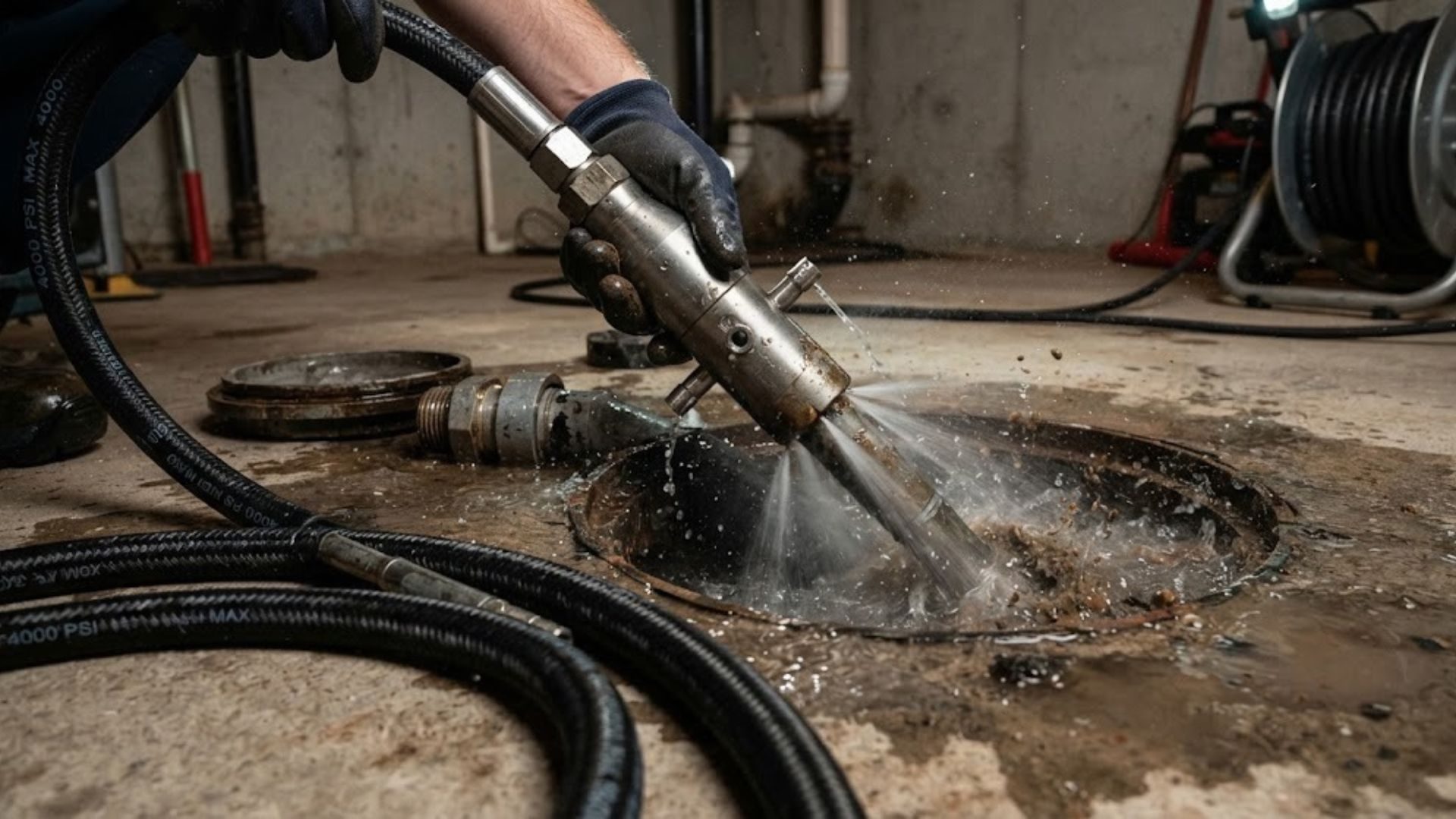
A hydro jetter is a truck- or trailer-mounted pump that feeds water at high pressure through a flexible hose. A nozzle on the end has several jets, most pointing backward. Those rear jets pull the hose forward through the pipe, while forward jets break up the blockage in front.
As the hose is slowly drawn back, the spinning spray washes the full circumference of the pipe wall. Grease, soap scale and fine silt are flushed toward the cleanout or the city connection. Rotating or chain nozzles can be selected when roots are the problem.
A good operator watches the water return, adjusts pressure for the pipe material and stops if something does not feel right. Pressure is a setting, not a maximum, and the pipe's age and material decide what is safe.
Snake, jetter or camera first
Picking the wrong tool wastes a visit. This table shows how the three approaches compare.
| Approach | Best for | Trade-off |
|---|---|---|
| Machine cable (snake). | Soft clogs, a single fixture, hair and paper. | Opens a channel only, grease stays on the wall. |
| Hydro jetter. | Grease, scale, silt, fine roots, slow main lines. | Not for cracked, collapsed or very fragile pipe. |
| Camera first. | Repeat clogs, unknown pipe condition, older lines. | Adds a step, but shows if jetting is safe. |
On older homes where we do not know the pipe, we lean toward the camera first. It costs less than repairing a line a jetter should never have touched.
How a jetting visit runs
The work follows a set order so nothing is jetted blind.
Find the access point
We locate the main cleanout, or the best alternative such as a pulled toilet or a roof vent, and confirm which line is slow.
Look before we blast
On a line of unknown age we send a drain camera first. A cracked or collapsed section changes the plan, and we tell you before any water goes in.
Jet in passes
The nozzle goes in toward the blockage, then is drawn back slowly while the spray washes the wall. Heavy buildup takes more than one pass.
Check the result
We run water through the line and, if you want proof, re-run the camera. You see what was removed, and we explain what the pipe condition means for the next few years. For a blocked sewer lateral, the sewer line cleaning page has the wider picture.
Grease and roots: the two jobs jetting does best
Grease is the leading problem in kitchen branch lines and in lines serving restaurants. Fat cools, hardens and traps food. A jetter melts and strips it away in a way a cable cannot. For a thick, hard layer, hot-water jetting or repeated passes may be needed.
Roots enter at joints, looking for moisture, and then thicken into a net that catches paper. Jetting with a root-cutting nozzle clears them back to clean pipe. Roots grow back, so a line with root intrusion often goes onto a maintenance schedule, or gets a repair if the joint is open. That repair decision is covered on our sewer line repair page.
For a one-fixture clog, the lighter tool is usually the right one. Our drain cleaning page explains when a cable is enough.
When jetting is the wrong tool
If the pipe is cracked, offset or collapsed, jetting can wash soil into the line or push water out into the ground, and it will not restore flow. Water that blows back through a cleanout, or a cable that stops at the same spot each time, are hints. We send a camera down before any jet in doubtful cases. The sewer camera inspection page covers what that look shows.
Caution with old cast iron and clay lines
Houses built before the 1970s often have cast iron or clay tile sewer lines. Cast iron corrodes from the inside, building up rough scale. Jetting can strip that scale, which sometimes exposes thin spots, so we set the pressure low and watch the return.
Clay tile comes in short sections with joints every few feet. Roots love those joints. Jetting clears the roots, but the joints stay open unless they are repaired or lined. That is why we may tell you jetting is a clean-out, not a cure.
Much of Minnetonka's single-family housing was built between 1950 and 1970. In a home from that era, the camera look first is a sensible default because the original lines may be among the oldest parts of the house.
Backup into the lowest drain in the house
If sewage or gray water is coming up through a basement floor drain, a shower or a tub, treat it as an emergency. Our 24/7 line is open nights and weekends, and a technician can assess the line the same day when the schedule allows.
A main line blocked by grease or roots will not clear itself. Here is what to do until we arrive.
- Stop all water use. That includes the washing machine and dishwasher.
- Do not flush and do not pour in a chemical opener.
- Keep people and pets out of the standing water. It is wastewater.
- Lift boxes, rugs and electronics off the floor if there is time.
- Find the main cleanout if you can. A plumber will start there.
- Tell dispatch how long drains have been slow before the backup.
Preventive jetting for restaurants and multifamily buildings
Some properties do not wait for a symptom. A restaurant kitchen sends fat and food solids into the line all day, and a building with 20 or more units pushes a great deal of water through shared stacks and one lateral. About 29% of Minnetonka's housing units are in buildings of that size, so scheduled jetting suits many managers.
A typical program runs the main on a fixed interval, with a camera pass now and then to track pipe condition. The interval depends on the load, and we help you set it. Commercial accounts can read more on our commercial plumbing page. We also serve Eden Prairie and Plymouth, where many multifamily and restaurant properties sit.
What affects the cost of a jetting visit
A jetting job varies more than a simple cable visit. These are the factors.
Insurers usually treat routine line cleaning as maintenance, which is not covered. A sudden sewer backup might be, but only with the right endorsement, so read your policy and call your insurer.
Questions about hydro jetting in Minnetonka
Yes. Our 24/7 line is answered around the clock, and a backup into your lowest drain gets priority. Same-day appointments are available when the schedule allows.
A cable opens a hole through the blockage. If grease or scale is coating the wall, the pipe refills. Jetting washes the wall itself, and a camera shows whether the pipe has other problems.
Often, yes. A jetter with a root-cutting nozzle clears roots from the pipe interior. If roots keep returning, the joint is open and may need a spot repair or a liner.
A slow main line is a warning, and the best time to jet is before the backup. Waiting means a full stoppage at the worst hour, often with sewage in the basement.
It depends on the pipe. Sound pipe handles it well. Cracked, collapsed or badly corroded pipe does not, which is why we run a camera before jetting a line we do not know.
Not always. For a known, sound line with a grease problem, jetting alone may be enough. For repeat clogs or older homes, we recommend the camera.
Yes. If the blockage is in the city main under the street, ask Minnetonka Public Works. A camera on the private line shows where the blockage is, and that tells you who to call.