
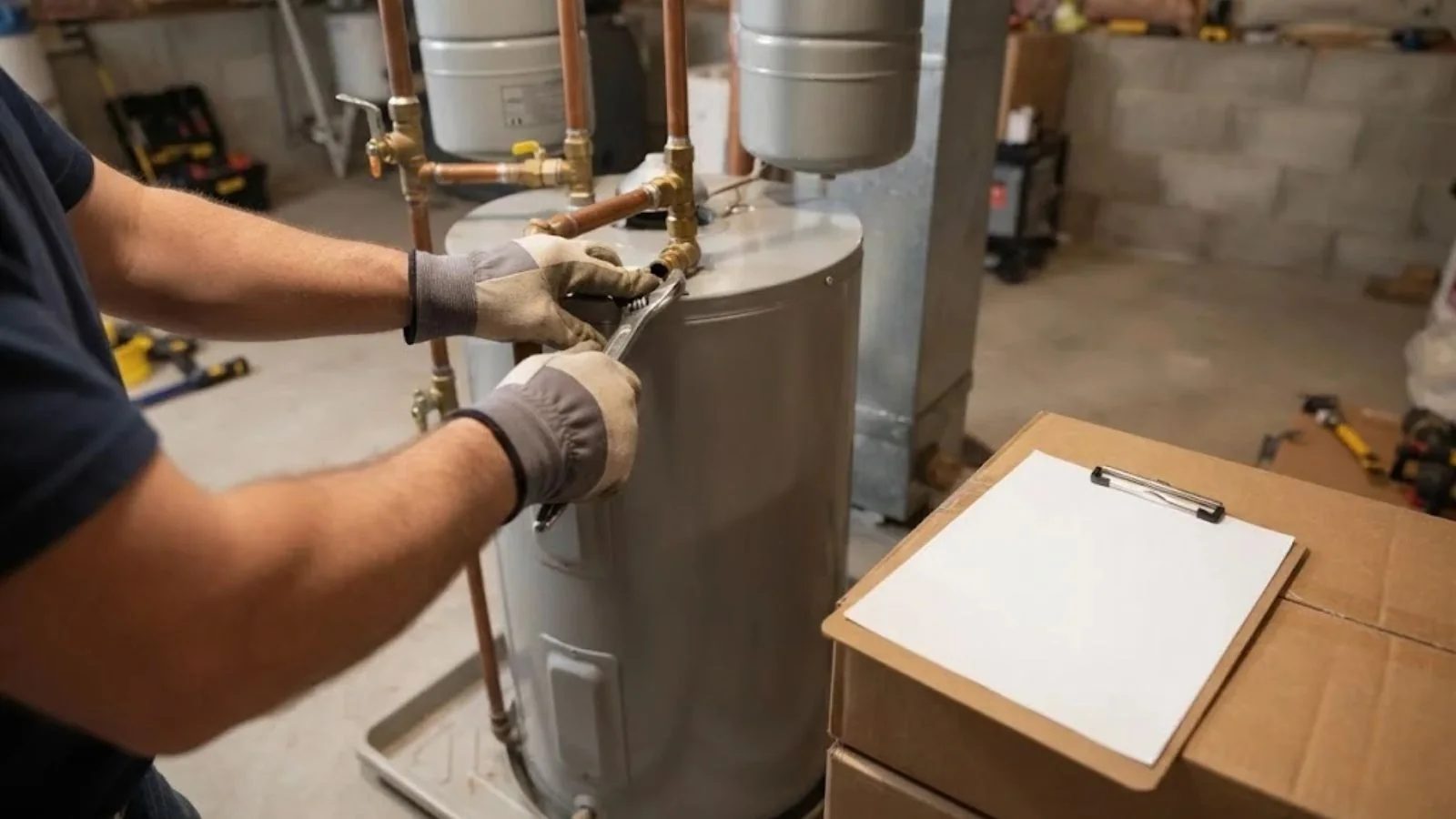
Leaking water heater or gas smell: do this first
A water heater that is actively leaking or a unit with a gas smell is an emergency, and we take those calls around the clock. A tank can move a lot of water onto a basement floor in an hour, and a gas leak is a safety problem before it is a plumbing one.
If you smell gas, do not touch switches or the phone inside. Leave the house, then call the gas utility or 911 from outside. Call us after the gas company has cleared the home so we can look at the unit safely.
- Turn off the cold water supply valve on top of the heater. It is usually a lever or round handle on the pipe running into the tank.
- Switch the heater off. On an electric unit, flip its breaker. On a gas unit, turn the gas control dial to off or pilot, unless you smell gas, in which case you leave first.
- Move boxes, stored items and anything electrical away from the pooling water.
- If water is coming out of the discharge pipe beside the tank, leave the valve alone and call. Do not cap or plug that pipe.
- Take a photo of the data label and the leak area so the dispatcher can plan parts for a same-day visit.
Symptom, likely cause and whether to repair
Most calls fit one of a handful of patterns. This table shows what each one usually means and where repair makes sense. It is a starting point, because a technician has to confirm the cause on the unit itself.
| Symptom | Likely cause | Repair or replace |
|---|---|---|
| No hot water, electric unit. | Failed heating element, thermostat or tripped limit switch. | Repair, parts are modest. |
| No hot water, gas unit. | Pilot or igniter fault, thermocouple, or gas control valve. | Repair, unless the valve and tank are both old. |
| Water pooling at the base. | Tank has corroded through, or a fitting above is dripping. | Fitting: repair. Tank: replace. |
| Discharge pipe dripping. | T&P valve opening from high pressure or temperature, or a worn valve. | Repair, then check pressure. |
| Rumbling or popping. | Sediment hardened on the tank bottom. | Flush if the tank is healthy. |
| Rusty or smelly hot water. | Anode rod depleted, or bacteria in the tank. | Anode swap or replace if tank is old. |
| Lukewarm only. | Broken dip tube, bad thermostat, or an undersized unit. | Repair. |
If a repair would cost close to a new unit, or the tank itself is the failed part, a replacement visit is the better use of money. The older the tank, the less a repair buys.
Where the water is really coming from
A puddle near a water heater does not always mean the tank has failed. Water runs downhill and follows pipes, so the wet spot can be a foot from the true source. Condensation on a cold tank, a dripping supply line above, a bad shutoff valve or a drain valve that does not seat can all fake a tank leak.
There are three common sources. A fitting leak is a drip at a union, a nipple or a flexible connector, and it is usually a repair. A T&P valve discharge means the safety valve on the side or top of the tank is opening and sending water down the discharge pipe, which points to excess pressure or heat, or to a valve that has worn out.
A tank leak is water seeping from the steel shell itself, often from the bottom seam or around the element ports.
The tank leak is the one that ends the unit's life. The glass lining and the anode rod protect the steel, and once corrosion cuts through, no patch will hold. Tightening or sealing a rusted tank only delays a larger spill. If the shutoff is closed and water still appears under the heater a few minutes later, treat it as a tank failure and plan for replacement.
Finding the source takes ten minutes with a dry rag, a flashlight and a moisture meter. We wipe every joint, run the unit through a heat cycle, and watch which spot wets first. If the leak runs along a pipe or under a slab, leak detection with acoustic listening or a thermal imaging camera tells us where to open the wall.
Water heater requirements are covered in section 4714.0504 of the Minnesota Plumbing Code, Minnesota Rules chapter 4714, and pressure relief valves are covered in section 4714.0608, the standards licensed plumbers follow.
No hot water right now
Cold showers in a Minnesota winter are an urgent call, and we treat them that way. Same-day appointments are available when the schedule allows, and the line stays open overnight and on weekends. Before you call, check two quick things: the breaker or gas dial, and whether the tank is actually leaking.
A heater with no hot water and a wet floor needs the supply shut off first. A heater that is simply cold and dry usually has a failed heating part, a tripped limit switch or an ignition problem. Those are repairs we often finish in a single visit when the part is on the truck.
Gas, electric and hybrid units fail in different ways
The repair depends on how your heater makes heat, so the first thing we read is the data label.
Gas tank units
Faults center on the pilot assembly, thermocouple or flame sensor, the gas control valve and the vent. A weak or yellow flame, soot, or a backdrafting vent needs attention right away, because combustion gases are involved.
Electric tank units
Two heating elements and two thermostats do the work. A failed upper element leaves you with no hot water, while a failed lower element gives a short supply. We test each with a meter before replacing anything.
Hybrid (heat pump) units
These pair a compressor and fan on top with backup elements. Repairs include condensate drain clogs, air filter issues, fan faults and element failures. Some compressor and sealed-system work belongs to the manufacturer's service channel, and we say so when that applies.
Tankless units
Scale on the heat exchanger, a dirty inlet filter and error codes are the usual causes. See our tankless water heater page for flushing and sizing.
What a repair visit includes
A repair call is a diagnosis first and a parts job second. A technician will work through these steps in order.
- Read the data label for model, age and fuel type, then check the venting and gas connection on gas units.
- Test the thermostat, elements or ignition parts with a meter instead of swapping parts by guess.
- Check the T&P valve, the discharge pipe and the water pressure at a nearby hose bib.
- Look at the expansion tank, because a failed one pushes pressure up and keeps the T&P valve dripping.
- Inspect the anode rod condition and sediment level when a flush or rod swap makes sense.
- State the repair price before work starts, so you can decide on repair or replacement with the full picture.
When repair is not worth it
A tank that leaks from the shell is finished, whatever its age. A unit near the end of a typical tank lifespan, with a failing element and a rusted base, is a poor repair bet. Parts for a gas control valve on an old heater can approach the cost of a new tank, and the next failure is often close behind.
We tell you plainly which side of the line your heater is on. If replacement is right, the same visit can plan sizing, venting and the permit question. See water heater installation for what a planned install involves.
What drives the cost of a water heater repair
The final price depends on what failed and how hard it is to reach. We quote it before work starts.
Sudden tank failures that damage floors and belongings are often covered by homeowners policies, while a slow leak or an old unit's wear is usually not. Read your policy and call your insurer, and keep photos of the damage.
How we handle a water heater call
The process is the same whether it is 2 pm or 2 am.
Call the 24/7 line
Tell the dispatcher the symptom, the fuel type and whether water is on the floor. We book same-day appointments when available and tell you what to shut off while you wait.
Diagnose on site
A licensed plumber tests the unit, finds the source and explains what failed in plain words.
Approve the price
You get a clear price before work starts. You choose repair or replacement.
Repair and test
We make the repair, run the heater through a full cycle and check for leaks, pressure and venting before we leave.
Licensed plumbers, and how to check any plumber
Water heater work touches gas, water and venting, so it belongs to licensed people. In Minnesota, plumbing work in communities over 5,000 residents requires a contractor license, and you can verify any plumber at the Minnesota DLI Check a License lookup. Minnetonka has about 54,000 residents, so that rule applies here.
Ask the City of Minnetonka building department whether your work needs a permit. Eden Prairie lists water heaters among its permit items, and Minnetonka's plumbing permit form states no exemptions, so assume a permit question is real. We serve Hopkins, Eden Prairie and the surrounding towns with the same 24/7 line.
Questions about water heater repair in Minnetonka
Yes. The 24/7 line is staffed overnight, on weekends and on holidays, and same-day appointments are available when the schedule allows. A leaking tank or a gas smell is treated as an emergency.
Water at the base is either a tank that has corroded through or a drip from the drain valve or a fitting above. A tank leak means replacement. Shut off the cold supply and call so we can confirm the source.
That is the T&P valve discharge. The valve opens when pressure or temperature climbs too high, or when the valve itself is worn. It is a safety device, so never cap it, and have it checked.
Yes. A flush clears sediment from the bottom of the tank, and we check the anode rod, T&P valve and expansion tank at the same time. A flush helps a healthy tank. It does not fix a tank that already leaks.
Codes vary by brand, and they point to a fault, such as ignition, venting or a sensor, instead of naming the part. Note the pattern of the blinks or the code, then call and we will diagnose it on site.
A shell leak means replace. If the unit is old and the repair is a large part, replacement usually makes more sense. We give you both options with a clear price before work starts.
No. Turn off the cold water supply and the power or gas, then call. Even a slow leak can rot a floor, and an electric unit sitting in water is a shock risk.