
What leak detection actually is
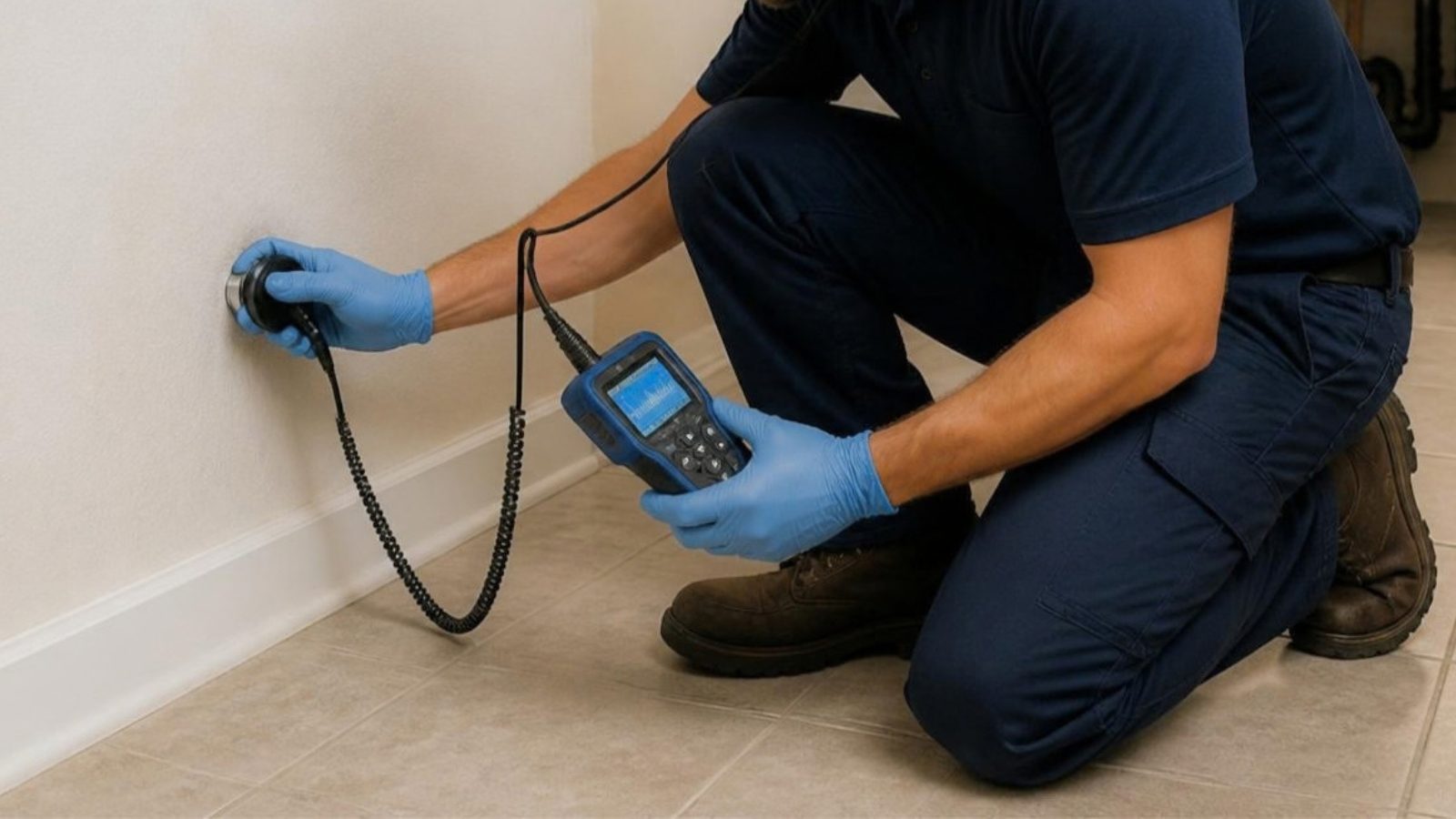
Leak detection is the work of locating a water leak you cannot see, using instruments instead of demolition. The goal is a precise spot on a pipe, not a guess that ends in a hole the size of a doormat.
A small drip behind drywall can run for weeks. It soaks insulation, lifts paint, feeds mold and drives up the water bill long before anything drips onto a floor. Finding it early is cheaper than any repair that follows. Once a leak is found, the repair is made to the Minnesota Plumbing Code, Minnesota Rules chapter 4714, and a licensed plumber is the right person to do it, according to the state's licensing standards.
What to do when a hidden leak is an emergency
Water you can hear running inside a wall, a ceiling that sags or bulges, or a floor that feels warm and wet is an active leak. Our 24/7 line takes these calls at night and on weekends, and same-day appointments are offered when available.
While you wait, cut the supply first. Every minute the pipe runs adds to the damage and to the cost of drying out.
- Shut off the main water valve, usually near where the line enters the basement wall, and turn it clockwise until it stops.
- Open the lowest faucet in the house to drain the pressure out of the pipes.
- Turn off power to any room with standing water or a wet ceiling. Use the breaker, and do not step into water to reach it.
- Move furniture, rugs and electronics out of the wet zone and put a bucket under any drip.
- Photograph the stain, the meter and any damage with the date visible, for your insurer.
- Call the 24/7 line and tell the dispatcher what you hear, see and where.
Symptom, likely source and how we find it
Most leaks announce themselves one way or another. This table matches what you notice to the usual suspect and the tool that confirms it.
| What you notice | Likely source | How it is found |
|---|---|---|
| Meter spins with everything off. | Service line, or a supply pipe or fixture. | Meter test, then acoustic listening and line tracing. |
| Bill climbs with no change in use. | Slow supply leak or a running toilet. | Meter test, dye test, pressure test. |
| Warm or damp floor patch. | Hot line leak in a slab or in-floor heat loop. | Thermal imaging and a moisture meter. |
| Stain or bubble on a ceiling. | Supply or drain line above, or a fixture seal. | Moisture meter, thermal camera, then access cut. |
| Low pressure that crept in. | Buried line leak or a failing valve. | Pressure test and tracing along the line. |
| Faint running sound at night. | Pinhole in copper or a loose fitting. | Acoustic listening, then tracer gas if it stays quiet. |
A stain tells you where water showed up. It rarely tells you where it started, because water follows framing, pipes and insulation before it drips.
Signs you have a leak you cannot see
Start with the meter. If the dial moves while every tap, appliance and toilet is idle, water is leaving the system somewhere. A bill that rises for no reason points the same way.
The body of the house gives hints too. Look for a musty smell in a closet or basement corner, paint that bubbles, baseboards that swell, a patch of floor that stays warm, or a hiss in the quiet of the night. Any one of these deserves a look. Two together nearly always mean a leak.
Low pressure at every tap, not just one, can mean water is escaping before it reaches the fixtures. A single weak faucet is usually a clogged aerator instead.
The tools that find a leak without demolition
No single instrument solves every case, so we stack methods and cross-check them. Each one narrows the search, and the last one pins the spot.
Acoustic listening uses a sensitive microphone on floors, walls and valves. Pressurized pipe that leaks makes a distinct hiss, and the sound peaks right over the break. Thermal imaging cameras show temperature differences, which makes a hot-water leak glow in a wall or slab. A moisture meter confirms that a surface is wet below the paint.
A pressure test isolates a section of pipe, holds it under pressure and watches the gauge for a drop. For leaks that stay quiet, tracer gas is a harmless mix pushed into the line. It escapes at the break and a handheld sniffer picks it up on the surface. Line tracing locates buried pipe so we dig in the right place. A drain camera checks drain lines when the water is leaving rather than arriving.
How a visit runs
The order matters because each step rules out something and saves digging later.
Walk-through and questions
We ask when you noticed the problem, where the water shows, and what changed. Then we look at the meter, the main valve, the water heater and the likely rooms.
Isolate the system
We shut sections of pipe off one at a time. If the meter stops when the hot side is closed, the leak is on the hot side, and the search area shrinks fast.
Instrument sweep
Acoustic gear, thermal imaging and the moisture meter go over the suspect area. We mark the spot on the surface so the access opening is as small as it can be.
Report and clear price
You hear what we found, what repair is needed and the price before work starts. Repairs can often follow the same visit when a plumber and parts are on hand.
Do the water meter test yourself
This takes ten minutes and costs nothing. Shut off every faucet, stop the dishwasher and washer, and make sure nobody flushes. Find the water meter, usually in the basement near the main shutoff, and open its lid if it has one.
Look for the small leak indicator on the face, often a triangle or a tiny wheel, or just watch the sweep hand and the digits. If anything moves with all water off, you have a leak somewhere past the meter. Note the reading, wait an hour with no water use, and check again. A changed number confirms it.
If the meter is steady, the loss may be inside one fixture or only when something runs. A running toilet is the usual culprit. Drop a little food coloring in the tank and wait. Color in the bowl without flushing means the flapper is leaking.
Some homes also have a remote reader mounted outside, which sends readings to the utility. Ask the City of Minnetonka Public Works utilities office how your meter and reader report usage, since that depends on your address and account. A high-use alert from the utility is a good reason to run the test.
High water bill with no obvious cause
A bill that jumps is often the first sign of a hidden leak. Toilet flappers, a failing irrigation valve and a pinhole in a supply line each waste water without any noise or mess.
Compare the last few bills and note when the climb started. If you added a guest, a pool fill or a lawn watering, that explains some of it. If not, run the meter test above, then call. We can then split the house from the service line, which tells us whether to look inside or under the yard.
Slab leaks and why they sound unlikely here
A slab leak is a leak in a pipe running in or under a concrete floor. Most Minnetonka homes have basements, so a full slab-on-grade house is not the default. That means the classic slab leak is less common here than in warm-climate homes.
Slab-level concrete still exists. Additions poured on a slab, attached garages, walkout lower levels, and floors with in-floor hydronic heat all have pipes at or under slab level. We make no claim about how often it happens locally, only that it is possible in those spots.
The signs are a warm patch on the floor, the sound of water under it, a damp spot with no source above, and a meter that spins with nothing on. Thermal imaging and acoustic listening are the first tools. Repair choices range from a spot repair after breaking a small section of floor to rerouting the line through the wall.
Leaks behind ceilings and walls
A ceiling stain usually sits below a bathroom, laundry or kitchen. Supply lines, drain lines, tub overflows and failed shower seals all drip down. The wet spot on the ceiling may be several feet from the real source.
We start with a moisture meter across the stain and the room above. A thermal camera shows a cooler or warmer patch where water is traveling. If the pipe is in a wall, acoustic listening on studs helps. The access cut is made only after the instruments agree, and it is sized to the pipe.
Do not paint over a stain until the cause is fixed. Stain-blocking primer hides it, and the leak keeps feeding the framing behind it.
Basement and crawlspace leaks
In a Minnesota home the pipes that matter most are often exposed in the basement ceiling, along the rim joist and through the utility room. That is good news, because a visual check, a moisture meter and a thermal camera find many leaks there without any cutting.
Look for drips from joints, green crust on copper, rust trails on galvanized pipe, or a wet patch on the floor that returns. Where a crawlspace or a low addition exists, we check under the floor for damp insulation and sagging subfloor above the pipe runs.
Not every wet basement is a plumbing leak. Groundwater through a floor crack or a sump pit that overflows looks similar, so we confirm the source before recommending a repair. If groundwater is the cause, a sump pump repair or basement waterproofing fits better than pipe work.
Buried water line leaks
The pipe from the street to your house runs underground, and when it leaks the signs are outside. Look for a soggy patch on the lawn that does not dry, a wet area along the path of the line, unusually green grass in a strip, or low pressure with a meter spinning.
We trace the line, listen along its path with an acoustic ground microphone, and pressure test it. That narrows the dig to a short stretch. What happens next is a repair question covered on our water service line repair page, including dig and trenchless options.
If you suspect the leak is on the city side of the meter, call the City of Minnetonka Public Works utilities office. We can still tell which side the loss is on once the meter and valve are isolated.
Leak detection for property managers and light commercial
About 29% of Minnetonka homes are in buildings of 20 or more units. In those buildings a leak often runs between units, and the first sign is a stained ceiling in the apartment below. That makes the hunt a coordination job as well as a plumbing job.
We trace shared risers, mark which unit the water enters from, and tell you whether the source is a supply stack, a drain or a fixture. For retail, offices and small commercial space, scheduled and after-hours access is possible by arrangement. Larger work sits with our commercial plumbing service. The same service reaches nearby towns such as Hopkins and Plymouth.
Keep a log of the date the stain appeared, the units involved and any tenant reports. It speeds the search and helps with insurance.
Sprinkler and irrigation leaks
Irrigation systems leak at valves, heads, glued fittings and the backflow preventer. A zone that stays wet after it shuts off, a head that sprays unevenly or a manifold box full of water are the signs. Wet spots in spring often trace to a fitting that split during winter freezing. We test zone by zone and check the backflow assembly. Where the system is a separate contractor's design, we tell you where the leak is and what part failed.
Pool, spa and meter-box leaks
For a pool or spa, the first check is whether the loss is water level only or water in the supply. A bucket test and a pressure test on the plumbing lines separate an evaporation loss from a pipe leak.
A wet meter box at the street or curb is a different case. Water pooling in the lid of the box can mean a failed fitting, and the part on the street side belongs to the utility, so call them first.
Why older Minnetonka homes leak more quietly
About 53.4% of Minnetonka homes were built before 1980, and much of the single-family stock dates from 1950 to 1970. Older supply lines, original drain pipes and aging joints mean pinholes and loose fittings show up with age. So the first move in an older house is a careful look at exposed pipe, a pressure test and, for drains, a camera.
What affects the price of leak detection
The work is priced by how hard the leak is to find and what it takes to reach it. You get a clear price before work starts.
Many policies cover sudden water damage but not a slow leak or the cost of fixing the pipe itself. Read your policy and call your insurer, and keep photos and the detection report.
After the leak is found
Once we have the spot, you decide the next step. For a short run of failed copper, burst pipe repair covers the cut-out and replacement. For a pipe that keeps failing, repiping is the longer fix.
Ask for the report in writing. It names the location, the pipe material and the test result. It also helps if you need to talk to your insurer or a landlord. If a permit is needed, ask the City of Minnetonka building department, since the city's form says work is not to start without one.
To check that anyone you hire holds a plumbing licence, use the Minnesota DLI Check a License lookup.
Questions about leak detection in Minnetonka
Yes. The 24/7 line is staffed around the clock, including nights and weekends, and same-day appointments are offered when available. Shut off the main valve while you wait.
Run the meter test. With every fixture off, a moving dial or leak indicator means water is leaving. Also look for a bill that climbed for no reason, a warm floor patch, a stain or a sound of running water.
Usually only a small opening, and only after acoustic, thermal and moisture readings agree on the location. Many basement leaks need no cutting at all.
It is a leak in a pipe under or in a concrete floor. Most homes here have basements, so it is not the default, but additions, garages, walkouts and in-floor heat can have pipes at slab level.
Yes. We trace the line, listen with an acoustic ground microphone and pressure test it. If the problem is on the city's side of the meter, Minnetonka Public Works handles that part.
Often yes, and it can waste a lot of water. A dye test in the tank shows a bad flapper. A quick fix is cheaper than a high bill.
Yes. We find which unit or riser a leak starts in and report it. Larger scopes go through our commercial plumbing service.
It depends on the policy. Sudden damage is often covered while gradual leaks are not, so read your policy and call your insurer before work begins.