
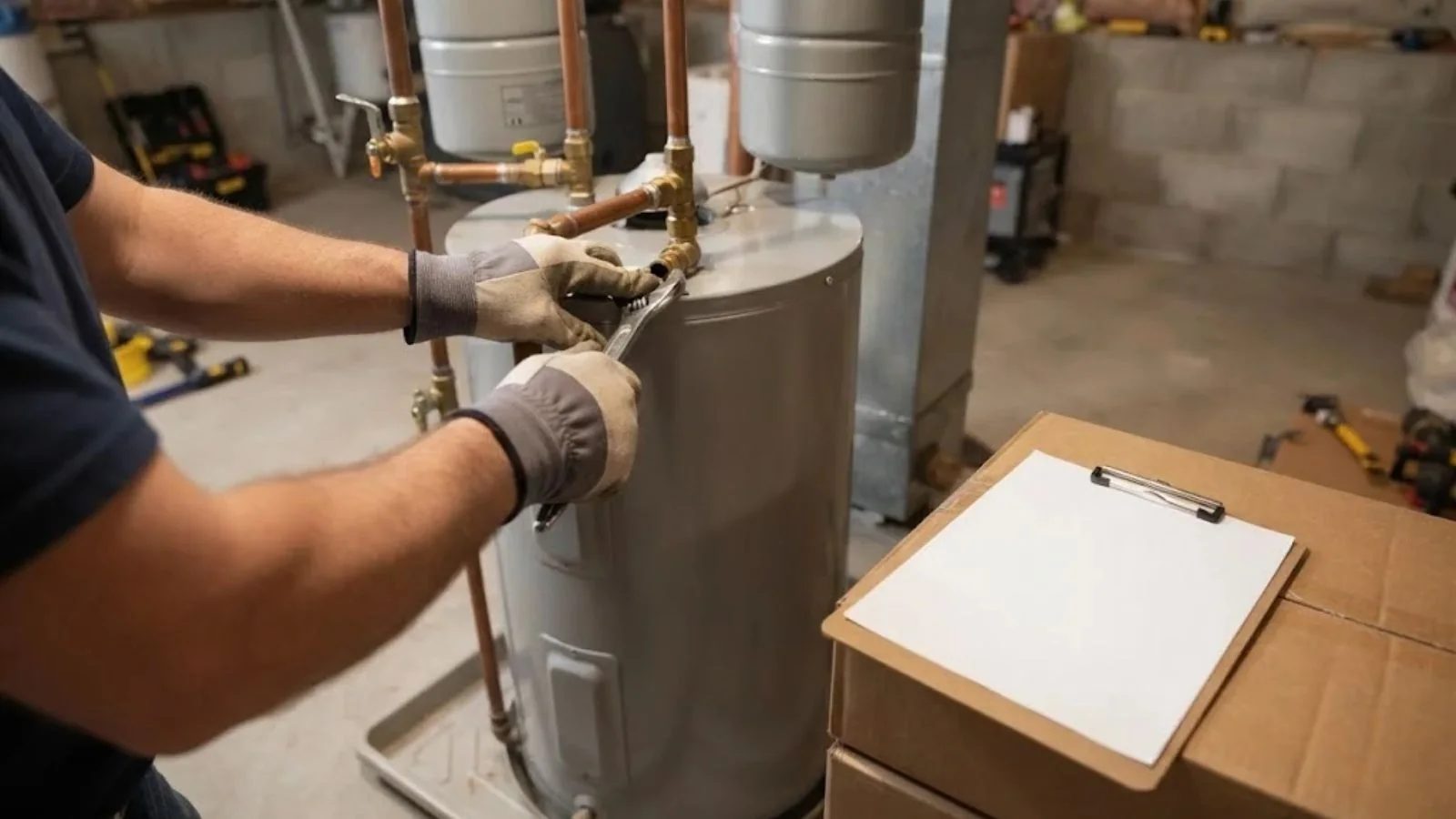
Is it really the element?
Only electric tank heaters have elements, so check the label first. A gas unit with a burner and a flue is a different repair, and gas work belongs to a licensed pro. On an electric tank, two elements heat the water: an upper one that starts the heating cycle and a lower one that does most of the work.
If the shower runs hot for two minutes and then turns cold, the lower element has usually failed. If there is no hot water at all, the upper element, a thermostat or the tripped high-limit button is more likely. Elements are cheap parts, but a wrong guess wastes an afternoon. Water heater requirements are covered in section 4714.0504 of the Minnesota Plumbing Code, and the manufacturer's instructions on the tank label set the electrical standards for the element.
What the symptom usually points to
Match what you notice to the likely part before you open anything.
| What you notice | Likely cause | Next move |
|---|---|---|
| Hot water runs out fast. | Failed lower element. | Test lower element. |
| No hot water at all. | Upper element, thermostat or tripped limit. | Check breaker, then test. |
| Breaker trips again and again. | Grounded element or shorted wiring. | Test for ground, call if unsure. |
| Water warm but never hot. | Weak thermostat or scaled element. | Test and inspect. |
| Water at the base of the tank. | Leaking tank or fitting. | Stop and call a plumber. |
Gather these before you touch the panel
Hunting for a part with a half-drained tank open is how a one-hour job becomes a night without hot water.
- A non-contact voltage tester and a multimeter that reads ohms.
- A replacement element with the same voltage and wattage printed on the old one and the nameplate.
- The same mounting style, either a screw-in thread or a four-bolt flange.
- A socket made for water heater elements, which is a deep thin-wall socket.
- A garden hose long enough to reach a floor drain or sump pit.
- A new gasket if your element does not come with one.
Why elements fail in the first place
Most elements die one of three ways. Scale builds up on the metal sheath until heat cannot escape and the coil burns through. Sediment piles around the lower element and buries it, so it cooks in a pocket of sludge. Or the sheath corrodes and a pinhole lets water reach the resistance wire, which trips the breaker.
That history matters for the repair. If the old lower element is caked white and crumbly, a new one will fail the same way unless you flush the tank. Open the drain valve for a minute with the hose attached and watch what comes out. Grit and flakes mean sediment is part of the story.
The swap, in order
Work slowly. Each step protects you from a different hazard.
Kill power and prove it
Switch off the dedicated breaker, then remove the access panel and insulation. Touch the tester to every terminal and wire. Trust the tester, not the breaker label.
Drain below the element
Close the cold water supply, open a hot tap upstairs to let air in, and run the hose from the drain valve to a floor drain. Drain until the water level sits below the element you are changing.
Test, then remove
Disconnect the two wires, set the meter to ohms and touch both terminals. A good element reads a low, steady resistance. An open reading means it has burned out. Then unscrew it with the element socket.
Fit the new element and refill
Seat the new gasket, thread the element in snug without forcing it, and reconnect the wires. Close the drain valve, open the cold supply and keep the hot tap open until water runs steadily with no spitting. Only then replace insulation, panel and breaker.
Never energize a dry tank
Elements are designed to sit underwater. Power them in air and they can burn out in seconds, and a new part ruined that way is common. Water must flow from the open hot tap and the tank must feel full before you switch the breaker back on.
After power returns, press the red reset button on the upper thermostat if it popped. If it trips again within a day, stop. Repeated tripping points to a wiring or thermostat fault that needs a licensed plumber or electrician.
Signs the tank, not the element, is the problem
An element swap makes sense on a heater that is otherwise sound. A rust-colored drip at the base, a tank that rumbles from sediment, or a T&P valve that discharges regularly means the tank is near the end. Do not open or cap the T&P valve to stop a drip. It is the safety device that prevents pressure buildup.
If you reach the same decision, our water heater repair visit can test thermostats and elements together, and a tired tank is better replaced than patched. Our replacement option is worth pricing when the heater is old, leaking or has already needed several parts.
A realistic split between homeowner work and a service call
Plenty of people can do this repair. You need to be comfortable with a meter, willing to stop when a reading looks odd, and able to confirm the power is dead. Wires burned at the terminals, melted insulation or a blackened thermostat are the cue to stop and call.
Cost is not only the element. A call covers testing both elements and thermostats, flushing sediment, checking the anode rod and T&P valve, and judging whether the tank has years left. That judgment is the part a parts-store visit cannot give you.
What Minnetonka homeowners should know about permits and water
Minnetonka runs its own water system, drawing groundwater from 18 wells that are 444 to 575 feet deep, and its 2025 drinking water report does not print a hardness figure. Mineral scale shortens element life, so test your tap or ask your water utility how hard your water is. Scale that crusts an old element is a sign to check the tank for sediment too.
The City of Minnetonka plumbing permit application says work is not to start without a permit. A residential owner applying for their own permit must own and occupy the home, which the form calls homestead. Ask the City of Minnetonka building department whether a simple element swap needs a permit, because the form lists no exemptions. Neighbors in Hopkins and Eden Prairie should ask their own city inspection offices.
Source: City of Minnetonka plumbing permit application and 2025 drinking water report.Questions about this topic
Yes, and many people do when one has failed from scale. Drain the tank below the lower element, and both can be changed in one visit.
Read the nameplate on the tank and the printed ratings on the old element. Fitting a higher wattage than the tank is rated for overloads the wiring.
The usual cause is power applied while air still surrounds it. A close second is heavy scale on the element surface, which traps heat.
Not always. You only need to lower the water below the element you are changing, but draining fully lets you flush sediment out too.
Gas heaters have no elements, and gas appliance work should go to a licensed plumber. Do not attempt gas valve or burner repairs yourself.
Use the Check a License lookup on the Minnesota Department of Labor and Industry website. Plumbing contractors in communities over 5,000 people must hold a plumbing contractor license.
Related plumbing help
If this problem is happening now, these pages cover the work and the towns the 24/7 line serves.