
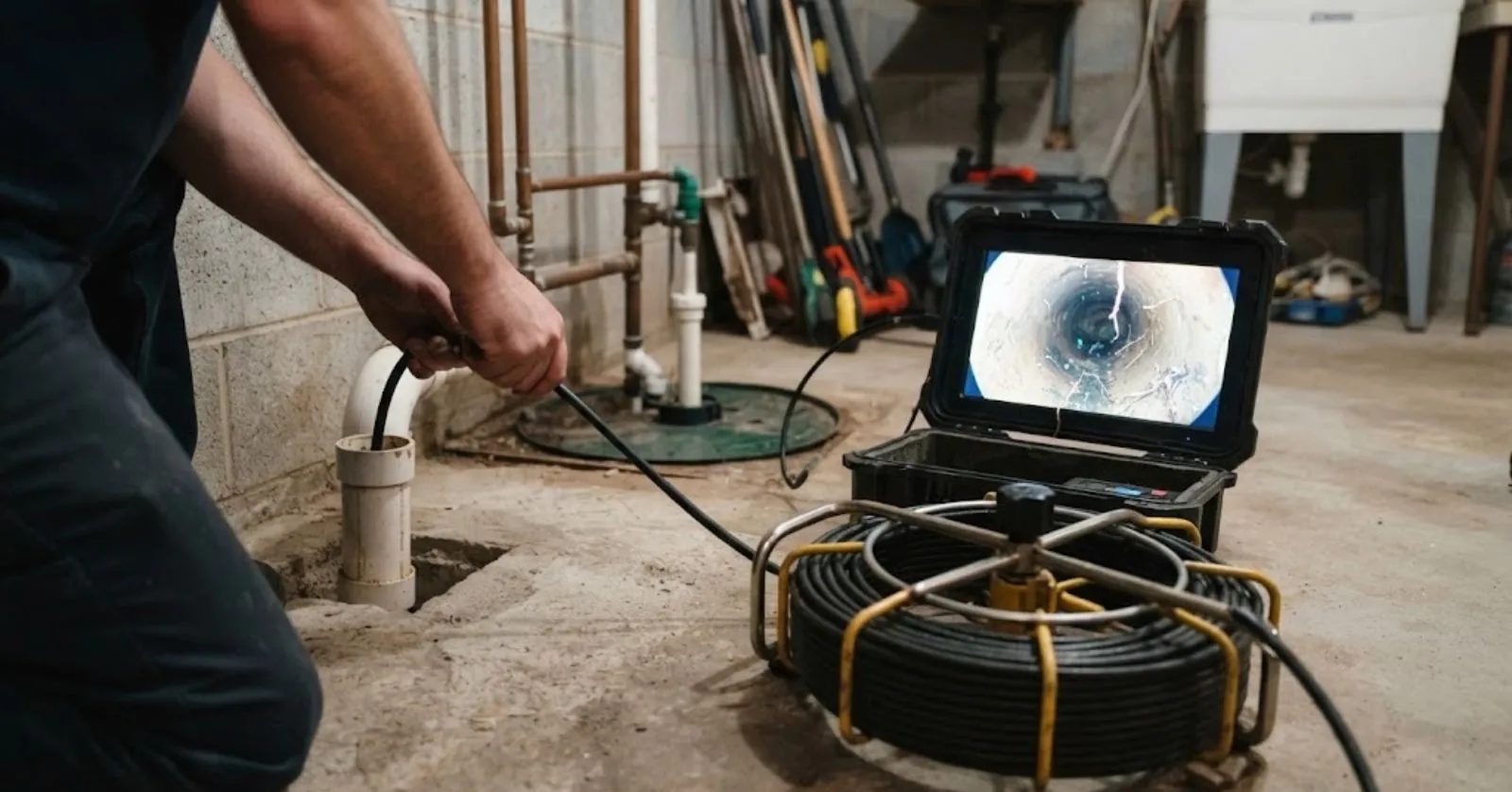
What the camera sees inside your line
A drain camera is a small, sealed lens on a flexible rod, with lights around it. It enters through a cleanout, a pulled toilet or a roof vent, and a monitor shows the pipe in real time. A transmitter in the head lets a locator on the surface follow its path and measure its depth.
The picture shows pipe material, joints, the water level, scale on iron, roots, cracks, offsets and bellies. It also shows whether a stoppage was a one-time plug or a sign that something in the pipe has changed. We record the run, so you can watch it and keep a copy.
The line is usually cleaned first so the lens can see. A pipe full of grease or paper looks like a solid wall on screen. A camera inspection finds the problem, and any repair that follows is governed by the Minnesota Plumbing Code in Minnesota Rules chapter 4714, plus the standards of the city that issues your permit.
What the camera finds, what it means and what comes next
Not every finding needs a dig. This table shows common results and typical next steps.
| What shows on screen | What it means | Likely next step |
|---|---|---|
| Grease or scale on the wall. | Narrowed pipe, repeat slow drains. | Hydro jetting, maintenance schedule. |
| Roots at a joint. | An open joint feeding roots. | Cut roots, then spot repair or lining. |
| Standing water in a dip. | A belly where waste settles. | Monitor, or replace that section. |
| Offset or separated joint. | Pipe has shifted, paper snags. | Spot repair or liner if shape allows. |
| Crack or missing pipe wall. | Leak into the soil, possible collapse. | Repair or replacement. |
| Clean, smooth pipe. | The clog was a one-off. | No repair, note for the record. |
Before you buy a house: the pre-purchase look
A general home inspection looks at fixtures and visible plumbing, but it cannot see an underground sewer lateral. A camera inspection fills the gap. For a buyer, it answers whether the line is sound, what material it is and whether roots or breaks are already there.
This matters most for older homes. Much of Minnetonka's single-family housing was built between 1950 and 1970, so a house of that era may have original clay, cast iron or fiber pipe still serving it. If the video shows trouble, you can ask the seller for repairs, adjust the offer or at least budget for the work.
Schedule the camera during your inspection period so there is time to act on what it shows. Ask the seller for cleanout access, and tell us if the house is vacant or on well and septic, since that changes the plan.
Recurring clogs are a reason to look, not to clear again
A line that clogs once is usually a fluke. A line that clogs every few months is trying to tell you something. Each extra cabling visit costs money and rarely fixes the cause, which might be a sag, a root intrusion or a collapsed section.
If your drain has been cleared and slowed again, put a camera on it. Then the next step, whether it is hydro jetting, a repair or a maintenance plan, is based on the pipe, not on repeating what did not work. Our drain cleaning page describes the usual first-line options.
Finding where the line runs
Sometimes the question is not what is wrong, but where the pipe goes. Before a landscaping job, a deck or an addition, you need to know where the lateral runs and how deep it is. We send the camera head in, and a locator receiver above ground picks up its signal, so we can mark the path on the surface.
Marking a private line does not replace a utility locate for public lines. Before any digging in the yard, Minnesota homeowners should arrange public utility locates through the state's call-before-you-dig system.
When waiting is a mistake
Camera work is not an emergency in itself, but some signs should not wait. A sewer smell that keeps returning, a sunken patch in the yard, or a drain that backs up when the washer runs all point to trouble. If sewage reaches the house, go to our sewer line cleaning page, or call the 24/7 line at once.
How an inspection visit goes
The visit is short and the steps are simple.
Tell us what you see
Share which fixtures are slow, and whether the home is being bought or sold, so we bring the right camera and locator.
Access and clean
We find the cleanout. If the pipe is dirty, we clear it enough to see the walls.
Run the camera
The camera travels to the connection, recording the pipe while we note distances and depth.
Review the video together
We play it back, explain every defect and give you a plain recommendation. A repair quote, if needed, is given before any work starts.
What affects the cost of a camera inspection
Camera work is a modest cost compared to a blind dig. These factors change the price.
Insurers treat an inspection as a maintenance or purchase cost, not a covered loss. If the camera finds damage from a sudden event, bring the video to your insurer, and read your policy to see what applies.
Questions about sewer camera inspection in Minnetonka
Usually yes. We can enter through a pulled toilet or a roof vent, though a proper cleanout makes the work faster and is worth adding if the line has none.
A camera head is smooth and flexible, and it does far less harm than a cable. Fragile or collapsed pipe can still block it, and in that case the stopping point is itself a finding.
Yes. Ask for a copy when you book. It helps with repair comparisons, insurance and a house sale.
For most homes, yes, and especially older ones. A regular inspection cannot see underground pipe, and a bad lateral is expensive to find after closing.
It can show cracks, missing pipe and water entering joints. For a pressurized supply leak, other tools are used, and our team can tell you which one fits.
Yes. The camera head transmits a signal, and a locator above ground follows it to mark the path and the depth. It does not replace public utility locates before digging.