
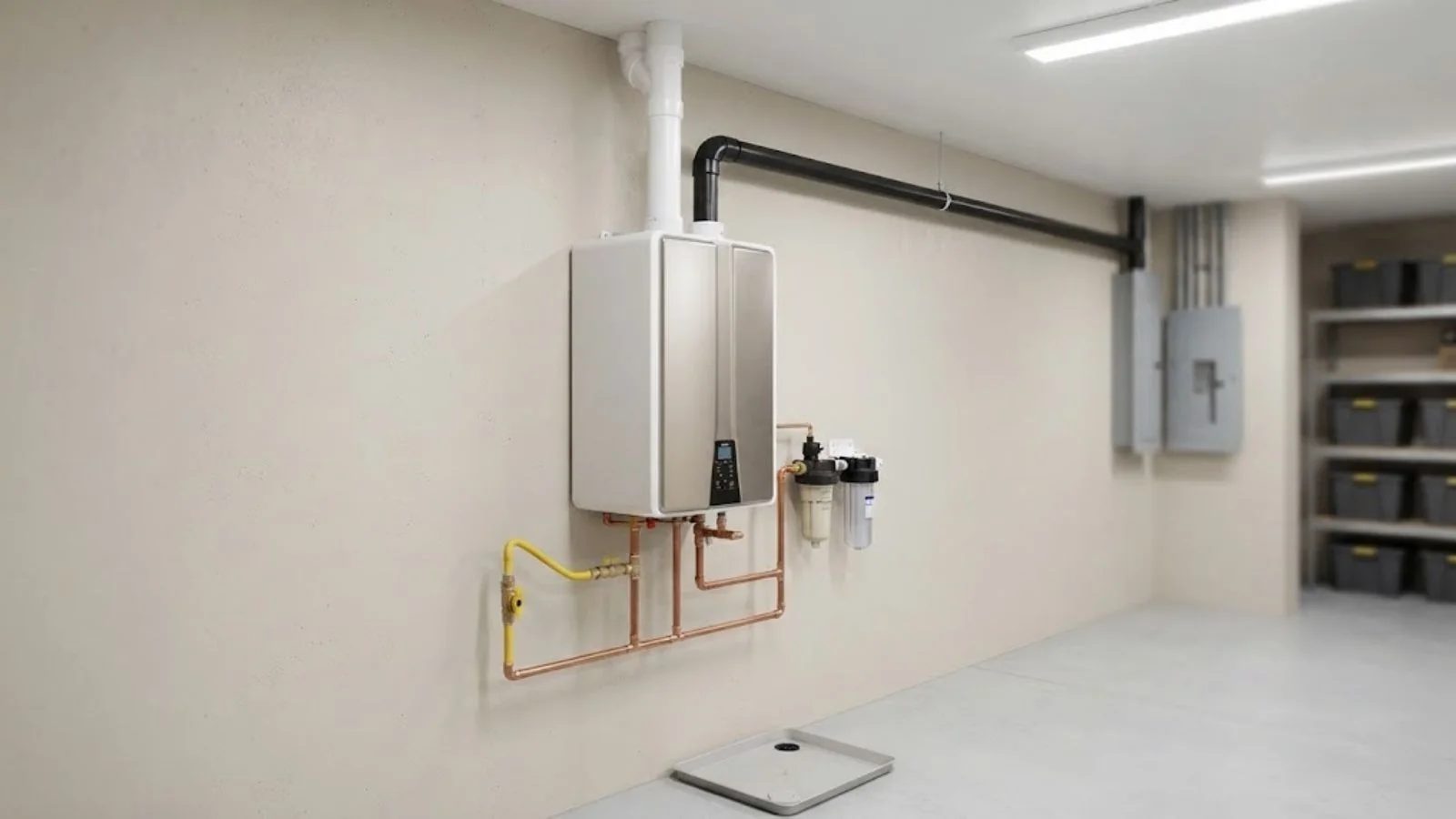
When your tankless heater stops behaving
Tankless units are sold as set-and-forget, and then the symptoms start. Hot water turns cold for a few seconds mid-shower. A code appears on the display. The flow weakens month by month. Or a technician arrives, shrugs and quotes a replacement without finding out why it failed.
The cold surge between two hot bursts is often called the cold water sandwich. It happens when you shut a tap briefly and reopen it, because water in the pipe cooled while the heater shut down and restarted. Some models handle it better than others, and a small buffer tank or a recirculation setup can reduce it.
Error codes are the heater's way of naming a fault zone, such as ignition, flame, exhaust, flow or temperature sensing. A code does not tell you the part. A unit that needs a flush, a cleaned inlet filter or a venting fix is often saved without a new heater, and we diagnose before recommending replacement.
Water heater installations have their own section in the state plumbing code, section 4714.0504, and gas units add venting and fuel gas rules, so ask the city which standards apply.
Flushing and scale: the maintenance tankless units need
Dissolved calcium and magnesium in the water leave scale on the heat exchanger when the water is heated. Scale narrows the passages, lowers flow and makes the unit work harder. It is the leading cause of error codes and early failure in tankless units.
A descaling flush circulates a mild acid solution, often white vinegar or a manufacturer-approved cleaner, through the heat exchanger with a small pump, then rinses it. We also clean the inlet screen and check the condensate path on high efficiency models. How often depends on your water.
Skipping the flush is where the trouble starts. A heat exchanger with a thin layer of scale still heats water, so owners do not notice until flow drops or a code shows up. By then the unit has been running hot and tight for months. A scheduled flush costs far less than the repair that follows from neglect.
We do not state a hardness figure for Minnetonka, because the city's drinking water report does not print one. Test your tap with a kit or ask your utility. By contrast, the City of Hopkins states its water is 21 grains of hardness, which means a tankless heater there builds scale faster. The City of Eden Prairie says its treated water averages about 5 grains per gallon, which means slower buildup but not none.
A water softener or a scale filter upstream protects the heat exchanger when your water is hard. See water softener installation if testing shows it is worth it.
Household use and how to think about sizing
Sizing a tankless heater is about flow and temperature rise, not tank gallons. Flow is how many fixtures run at once. Temperature rise is the gap between cold incoming water and your set temperature, which is large in a Minnesota winter.
| Household use | Sizing thinking | Watch-outs |
|---|---|---|
| One or two people, one bath. | Moderate flow, one fixture at a time. | Check the minimum flow needed to fire the burner. |
| Family, two showers at once. | Higher flow at full winter rise. | Gas line and vent size often limit the choice. |
| Large tub plus showers. | High flow, possibly two units. | A big fill competes with other fixtures. |
| Long pipe run to the fixture. | Wait time and cold surge. | Consider recirculation or a point-of-use unit. |
| Vacation or seasonal use. | Low standby loss helps. | Drain the unit if the house will freeze. |
Flow and temperature rise, in plain terms
Two numbers decide whether a tankless heater keeps up. Flow is how much water you ask for at once, counting every shower, dishwasher and tap that runs together. Temperature rise is how many degrees the heater must add between the cold water entering the house and the temperature you want at the tap.
Minnesota groundwater arrives cold in winter, so the rise is large and the heater has to work harder than it would in a warm climate. A unit that satisfies two showers in July can fall short in January. We size for the cold season, because that is when complaints come in.
Fixture choice matters too. Low-flow showerheads help the heater, while a large soaking tub that fills fast pulls hard on it. If your household has one heavy use, we can plan around it rather than oversizing everything.
How a tankless water heater works in a Minnetonka house
A tankless water heater has no storage tank. When a hot tap opens, a flow sensor starts the burner or heating elements, and the heat exchanger raises the temperature of the water as it passes through. Hot water lasts as long as the flow does, which is the main appeal.
The price of that endless supply is capacity. A gas unit may draw several times the fuel of a tank heater when it fires. Many Minnetonka homes were built between 1950 and 1970, and the city's housing chapter says most multifamily buildings date from the 1970s and 1980s. That age often means a gas line sized for a tank heater, so we measure supply before we promise a model.
Gas line, venting and condensate in older homes
These three items cause more tankless problems than the heater itself.
- Gas capacity: a larger burner may need a bigger gas line or a shorter run, which a licensed plumber must size and pipe.
- Venting: high efficiency units use sealed plastic vent pipe, while older flues cannot be reused as they are.
- Condensate: acidic condensate drains from the heat exchanger and needs a neutralizer and a safe drain path.
- Water pressure and filter: low incoming pressure or a clogged filter triggers flow faults.
- Fuel gas piping in Minnetonka needs a city license, a state bond and a mechanical permit.
Repair, service or replace
Many tankless problems are service problems, not product failures: scale, a dirty screen, a loose vent, a bad sensor. We start with a flush, a code check and a flow test. If the heat exchanger itself is cracked or the board is dead on an old unit, replacement may be the honest advice.
For emergencies, see water heater repair. If the unit is beyond saving, replacement covers the swap, and installation covers a planned conversion from a tank.
Tankless installation versus tankless repair
The two jobs start differently, and we treat them that way.
Repair or service call
We read the code, check flow, inlet filter, venting and condensate, and flush the heat exchanger if scale is the cause.
Conversion from a tank
We assess gas capacity, vent path, electrical outlet and drain, then price the changes before you commit.
New unit sizing
We match flow and temperature rise to your household, and tell you honestly if a tank suits you better.
Start-up and walkthrough
We test temperature at several fixtures, set the controls and show you the service valves and filter.
What shapes tankless costs
The unit is only one line on the quote.
Maintenance, scale damage and wear are not covered by homeowners insurance. A sudden leak that damages the home may be, so read your policy and call your insurer.
Who installs and services tankless units
Gas, venting and pressure work require a licensed plumber. Verify any plumber at the Minnesota DLI Check a License lookup. We are licensed and insured, we give a clear price before work starts, and same-day appointments are available when the schedule allows. Nearby customers in Plymouth and Minnetonka reach us on the same 24/7 line.
Questions about tankless water heater in Minnetonka
This is the cold water sandwich. Water in the pipe cools while the heater restarts. Check for scale, a clogged filter and low flow, and ask about a buffer tank or recirculation.
It names a fault area such as ignition, exhaust, flow or temperature, not the part. Write down the code, then call and we will diagnose on site.
It depends on your water. Test your tap or ask your utility about hardness, and check your manufacturer's schedule. Hard water calls for more frequent flushes.
Yes. We circulate a descaling solution through the heat exchanger, clean the inlet screen, check condensate drainage and test flow and temperature.
Maybe. Tankless units draw more fuel than tank heaters, and an older line may need upsizing. We measure capacity before recommending a model.
Not in the usual sense, but it has a flow limit. Too many fixtures at once can exceed capacity, which sizing and sometimes two units address.
It depends. Tankless saves space and supplies continuous hot water, but it needs gas and vent capacity and regular descaling. A tank can be the simpler choice in an older house.