Toilet overflowing right now
An overflowing toilet is an emergency, and it is time sensitive. Water on a bathroom floor reaches subfloors and the room below quickly. We answer the 24/7 line at night and on weekends, and same-day appointments are available when the schedule allows.
Here is what to do in the first minutes, before anyone arrives.
- Reach behind the toilet and turn the oval or round supply valve clockwise to close it.
- If the bowl is still rising, lift the tank lid and push the flapper down to stop more water entering.
- Do not flush again. Each flush adds more water to a blocked drain.
- Lay towels around the base and mop up water, wearing gloves if it is wastewater.
- Keep paper towels, wipes, diapers, feminine products and toys out of the bowl.
- If other drains gurgle or back up as well, stop all water use and say so on the call.
Repair it or replace it: how we decide
A toilet is a simple fixture, and many of its failures are cheap to fix. A worn flapper, a failed fill valve or a tired wax ring can each be changed in a single visit, and the toilet works like new. We start with the least expensive repair that will hold.
Replacement makes sense when the porcelain is cracked, when the bowl has been repaired several times, or when you want a better flush. Older tanks often use much more water per flush than newer models. Many people choose to replace a toilet when it keeps clogging, since a poor trapway design is not something repair can change.
When we replace a toilet, we remove the old one, check the flange and the floor, set a new wax ring or seal, level the bowl and test the flush. We take the old toilet away if you want. Our work comes with a clear price before it starts.
Toilet symptoms, likely causes and the fix
Most toilet calls fit one of these patterns.
| What you see | Likely cause | Typical fix |
|---|---|---|
| Water around the base. | Failed wax ring or loose bolts. | Reset the toilet with a new seal. |
| Bowl rocks or shifts. | Loose closet bolts, damaged flange. | Tighten, shim or repair the flange. |
| Tank keeps running. | Worn flapper or fill valve. | Replace the part. |
| Water on the floor near the wall. | Supply line or shutoff valve leak. | Replace the line or valve. |
| Weak flush or slow bowl. | Partial clog or low tank water. | Clear the trap, adjust the tank. |
| Gurgling with other drains slow. | Blocked main or sewer line. | Clear the main line. |
A rocking toilet and the flange underneath
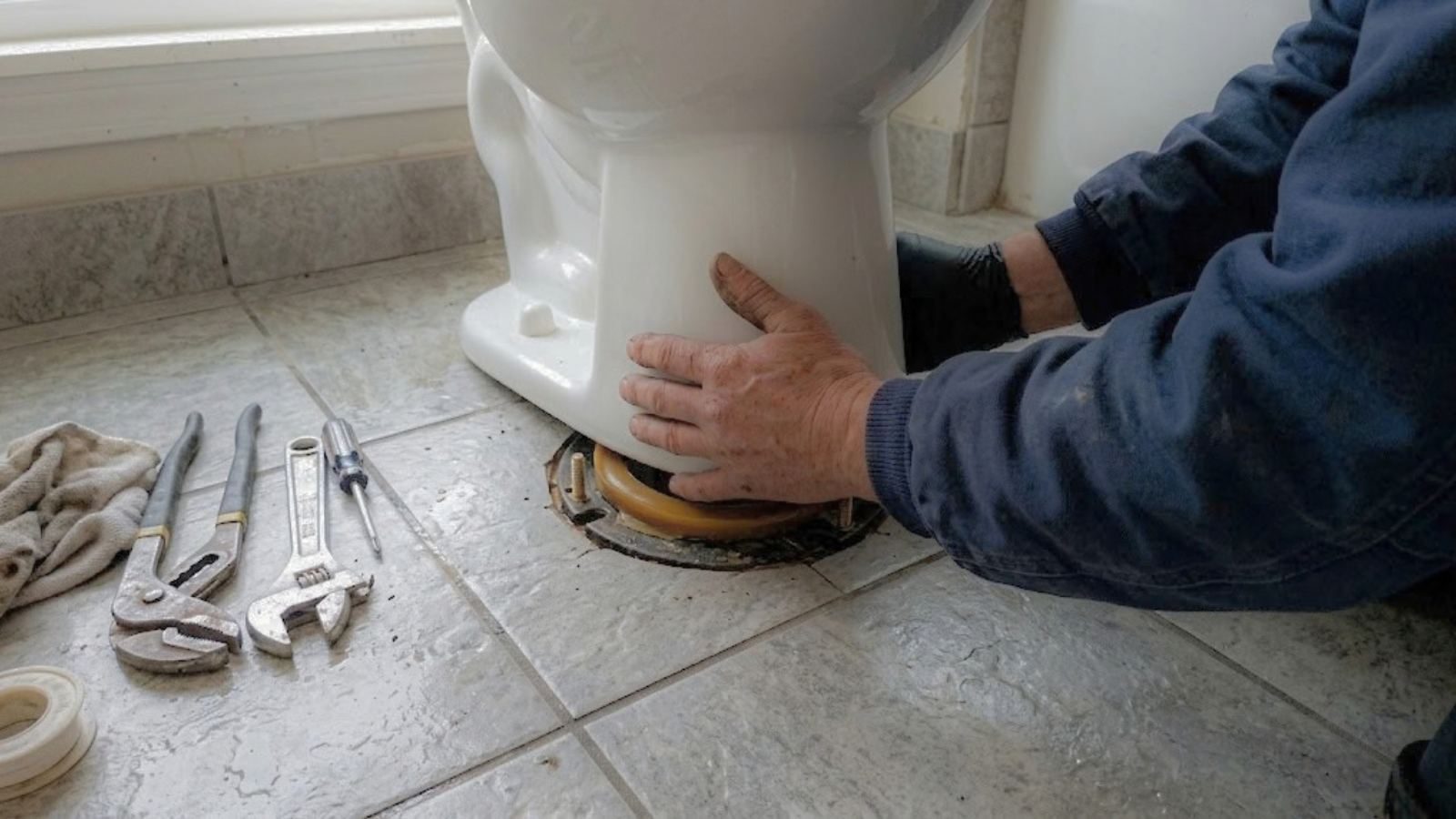
The toilet sits on a flange, a ring fixed to the drain pipe and screwed to the floor. Two closet bolts hold the bowl to the flange. If the bolts loosen or the flange breaks or sits too low, the toilet will rock, even a little. That movement breaks the wax seal, and water slowly escapes.
Do not use the toilet if it rocks and the floor around it feels soft. Over time, leaking water rots the subfloor, and the repair then grows from a toilet job into a carpentry job. We lift the toilet, inspect the flange, repair or replace it, and reset the bowl on a new seal.
Base leaks and the wax ring
The wax ring, a ring of wax or a modern foam seal, sits between the toilet outlet and the flange. It keeps water and sewer gas from escaping. When it fails, you may see water around the base after a flush, smell sewer gas, or find a dark stain on the floor.
A wax ring is a short-lived part when the toilet moves. A quick test is to dry the base fully, then flush and check again. If water comes out from beneath the bowl, the seal is the problem. If the water seems to come from the tank bolts or the supply line, the cause is higher up, and the fix is different.
Running toilets and tank leaks
A running toilet wastes water around the clock, and it often leaks slowly enough to go unnoticed. The usual culprits are a flapper that no longer seals, a float set too high or a fill valve that fails to shut off. A dye tablet in the tank, left for fifteen minutes without flushing, shows a leaking flapper if color seeps into the bowl.
These parts are inexpensive. If a supply valve under the tank is stuck or drips, we replace it too, since a good shutoff is what saves you in the next emergency.
When the toilet backs up with other drains
One toilet that will not flush is a toilet problem. A toilet that gurgles while the tub or basement drain acts up is a sewer problem. Water may appear in the lowest fixture in the house, which is usually the basement shower or floor drain.
If that is what you see, stop using water and read our sewer line cleaning page, or call the 24/7 line. About 29% of Minnetonka's housing units are in large buildings with shared stacks, and in those a clog above can show up in your toilet. Tell dispatch if neighbors have the same trouble.
How a toilet replacement goes
A replacement takes a short visit when the flange and floor are in good shape.
Shut off and drain
We close the supply valve, flush out the tank and sponge the bowl dry.
Pull the old toilet
We disconnect the supply line, remove the bolts and lift the bowl clear, then clean the flange and inspect the floor.
Set the new toilet
A new wax ring or seal goes down, the bowl is set and leveled, and the bolts are tightened evenly.
Connect and test
We connect a new supply line, run several flushes and check every joint for weeping. For a first-time install, other plumbing installation work can be done on the same visit.
What shapes the cost of toilet repair
A toilet job can be a ten-minute part swap or a floor repair. These factors set the price.
A sudden overflow or supply line burst that damages the floor may be covered, but a slow seep from a worn wax ring is usually seen as maintenance. Read your policy and call your insurer, and take photos before cleaning up.
Do you need a permit to replace a toilet?
Permit rules vary from city to city, and we do not guess. Ask the City of Minnetonka building department whether your project needs a permit. The city's plumbing permit form says work is not to start without one, so ask before the work, and do the same if you live in a nearby town such as Excelsior or Eden Prairie.
Questions about toilet repair in Minnetonka
Yes. The 24/7 line is answered around the clock, so an overflowing or leaking toilet at night or on a weekend gets a call-back path. Same-day appointments are available when the schedule allows.
Find the small valve on the wall or floor behind the toilet, and turn it clockwise until it stops. If it will not move, close the main water shutoff and call us.
Often, yes. A rocking bowl breaks the seal, so the wax ring is replaced when the toilet is reset. We also check the closet bolts and the flange.
The flapper may not be sealing, or the fill valve may not be shutting off. Both are inexpensive parts, and a plumber can replace them on one visit.
Usually the house shutoff is closed while the old valve is cut out and a new one is fitted. It is a short job, and it removes the risk of a stuck valve in an overflow.
Both drain into the same line. A partial blockage or a vent problem makes air move backward through the toilet. If other fixtures are slow too, the main line may be blocked.
If the porcelain is sound and the problem is one part, repair is usually enough. If it is cracked, clogs often or has been repaired repeatedly, replacement is the better value.