
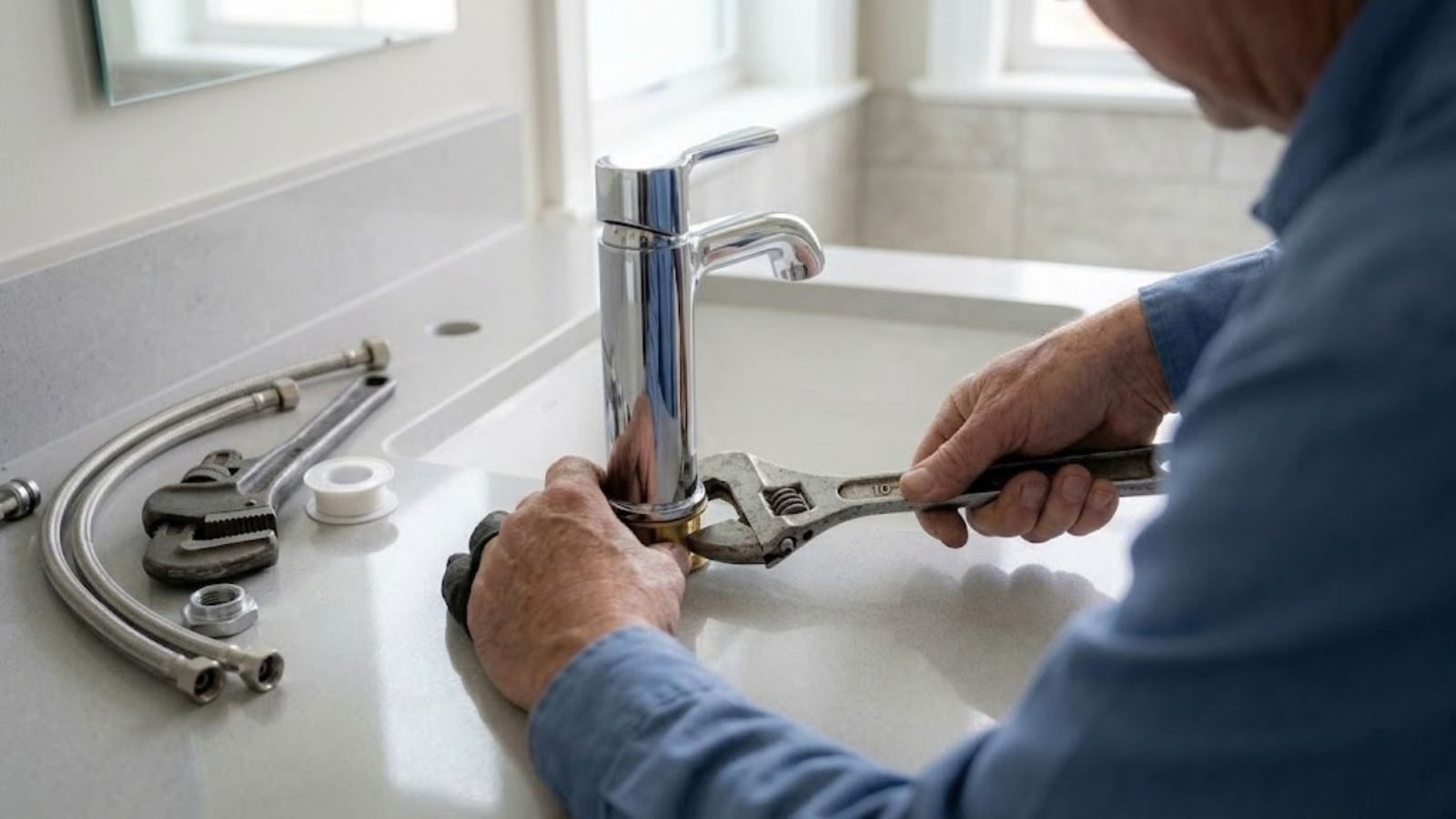
A loose handle is usually a screw, not a dead faucet
A kitchen faucet handle is a lever that turns a valve inside the faucet body. When the handle wobbles, the cause is almost always a small set screw that backed out. When it feels gritty or stiff, the culprit is the cartridge or the stem inside, coated with mineral scale. When water seeps around its base, an O-ring or seal has worn out.
None of these means you need a new faucet. Each is a part that costs a fraction of a replacement, and most are reachable with a hex key and a flat screwdriver. The trick is naming the symptom first, so you buy the right part once.
Faucet work is covered by the Minnesota Plumbing Code, Minnesota Rules chapter 4714, and the Wayzata city page says like-for-like faucet swaps there do not need a permit if the piping is unchanged, which is a local standard and not a state one.
Symptom, likely cause and the fix
Match what you feel and see to the likely cause before you take anything apart.
| What you notice | Likely cause | Fix |
|---|---|---|
| Handle wobbles or points the wrong way. | Set screw loose. | Tighten with a hex key. |
| Handle stiff or gritty to turn. | Scale on cartridge or stem. | Clean or replace cartridge. |
| Drip from the spout when off. | Worn cartridge or seat. | Replace cartridge. |
| Water around the handle base. | Failed O-ring or seal. | Replace the O-rings. |
| Handle spins but water does not change. | Stripped handle or broken stem. | Replace handle and stem parts. |
| Weak flow with a fine spray. | Clogged aerator, not the handle. | Unscrew and soak the aerator. |
Replacing a single-handle cartridge
This is the repair behind most stiff and dripping handles. Allow an hour and a towel for the sink bowl.
Shut off the water and relieve pressure
Close both stop valves under the sink by turning them clockwise. Open the faucet to drain what is left in the lines. If a stop valve will not turn or keeps leaking after you close it, stop there, because the next move is a plumber, not a harder twist.
Remove the handle
Pry off the small cap on the side or top, then loosen the set screw it hides with a hex key. Lift the handle off. If it is stuck, a rag soaked in warm vinegar around its base for ten minutes often loosens the scale.
Pull the old cartridge
Unscrew the retaining nut or clip, then twist and lift out the cartridge. Photograph its orientation before it leaves the faucet, because it goes back in only one way.
Match and install the new one
Take the old cartridge to a plumbing supply counter so the new one matches in brand and size. Coat the new O-rings with plumber's grease, seat the cartridge, tighten the nut, replace the handle, then open the stops slowly and check for drips.
Do not skip the little stuff
Clean the inside of the faucet body with a soft brush before the new cartridge goes in. Grit left behind scores the new O-rings and you will be back under the sink in a month. Run the faucet at full flow for a minute with the aerator off to flush any debris out of the spout.
Three leaks that look like handle problems
Water under the sink is not always the handle's fault. Check these before you buy parts.
Supply line connections
Dry a braided supply line with a paper towel, then run your fingers along it. A damp nut at the stop valve or faucet shank points to a loose or worn connection, not the cartridge.
A cracked sprayer hose
On pull-down faucets, the hose under the sink can wear against the cabinet and drip only when the sprayer is in use.
Condensation on cold lines
In humid weather, cold supply lines sweat and the drips look like a leak. Wipe them dry and watch whether the wetness returns after the weather changes.
Why it wears out faster in some kitchens
Cartridges are ceramic or brass discs sliding against rubber seals. Hard water leaves calcium and magnesium on those surfaces, which grinds the seals and sticks the handle. A kitchen with heavy scale on the aerator and showerhead usually has the same buildup inside the faucet.
If the same faucet fails every couple of years, the answer may not be another cartridge. A water softener or filtration system treats the water for the whole house, and it also protects the water heater and dishwasher.
What Minnetonka homeowners should know about hardness and faucet parts
Your water decides how often you do this repair. Hopkins states on its city water page that its water is 21 grains of hardness, which is high and means cartridges there scale up quickly. Eden Prairie treats its water at its own plant, and the city says treated tap water averages about 5 grains per gallon.
The City of Minnetonka's Drinking Water Report does not print a hardness figure, so test your tap with a hardness strip kit or ask your water utility. The Minnesota Department of Health says a softener may be worth considering when hardness runs above 7 grains per gallon. Softener brine also ends up as waste, so size and settings matter.
Source: City of Hopkins and City of Eden Prairie water pages, Minnesota Department of Health.Before you drive to the supply counter
- Take a phone photo of the faucet brand mark and the handle style.
- Bring the old cartridge or stem in a sandwich bag.
- Buy new O-rings and a small tube of plumber's grease.
- Check that your hex key size fits the set screw before you start.
- Put a towel or dish rag over the drain so small parts cannot fall in.
- Skip thread tape on the cartridge, since most seal with O-rings.
Repair, replace or hand it off
Repair when the faucet body is sound, the finish is intact and parts are available. Replace when the body is pitted, the handle housing is cracked, or the faucet is old enough that makers no longer stock cartridges. A faucet repair visit from a licensed plumber covers both and gets the stop valves checked at the same time.
For Hopkins kitchens with a long history of scale, Hopkins plumbers can compare the faucet, stop valves and supply lines in one stop. If you live south of Minnetonka, a plumber serving Eden Prairie can swap the faucet and test the shutoffs the same day when appointments are available.
Questions about this topic
A hidden set screw under the cap or in the side has probably backed out. Tighten it with a hex key. If the handle keeps loosening, the handle's internal splines may be stripped and the handle needs replacing.
Scale on the cartridge is the usual cause. Shut off the water, remove the handle, and either clean the cartridge in vinegar or replace it. A new cartridge is often the cheaper long-term fix.
Normally the two stop valves under the sink are enough. If those valves leak or will not close, shut off the main and call a plumber to replace them.
The valve seat inside the faucet body may be pitted, or grit got past the new seals. Flush the body, check the seat, and if it still drips, the faucet may be past repair.
Rarely. Most handles hide a set screw that needs a hex key, and a stuck handle may need a puller. A small tool kit costs less than a service call for a simple repair.
The City of Minnetonka's Drinking Water Report does not print a hardness figure, so you cannot tell from the report. Test your tap with a strip kit, or ask your water utility. Scale on your aerator is a decent hint.
Related plumbing help
If this problem is happening now, these pages cover the work and the towns the 24/7 line serves.